|
|
Haze Gray Photo Feature"Flush Deck" DestroyersAll-Purpose Ships |

![[THUMBNAIL]](fdck17.jpg) USS Dent (DD 116) in 1918, in camoflage paint.
Schemes such as this were common during WWI. Dent survived
through WWII as an APD, and was scrapped postwar.(National Archives
photograph)
USS Dent (DD 116) in 1918, in camoflage paint.
Schemes such as this were common during WWI. Dent survived
through WWII as an APD, and was scrapped postwar.(National Archives
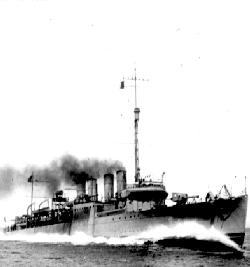
photograph) ![[THUMBNAIL]](fdck01.jpg) USS Brooks (DD 232) underway at high speed, 27 May 1920, probably
on builder's trials. She became a transport (APD 10) in 1942 and was
damaged beyond repair by Kamikazes on 6 Jan 1945. (National Archives
photograph)
USS Brooks (DD 232) underway at high speed, 27 May 1920, probably
on builder's trials. She became a transport (APD 10) in 1942 and was
damaged beyond repair by Kamikazes on 6 Jan 1945. (National Archives
photograph)
![[THUMBNAIL]](fdck02.jpg) USS Melville (AD 2) with a nest of 6 destroyers, 10 Nov 1932.
The tender, despite being launched in 1929, served through WWII to be broken
up in 1949. (National Archives photograph)
USS Melville (AD 2) with a nest of 6 destroyers, 10 Nov 1932.
The tender, despite being launched in 1929, served through WWII to be broken
up in 1949. (National Archives photograph)
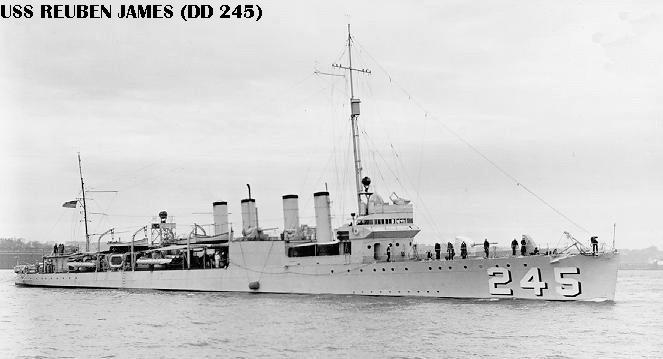 USS Reuben James (DD 245) in Chinese waters before WWII.
Reuben James lead an uneventful life prior to WWII, making photos
of her somewhat rare. She will be forever remembered, however, as the
first US ship sunk by the Germans, as she was torpedoed by a U-boat 30
October 1941. (USN Official Photo)
USS Reuben James (DD 245) in Chinese waters before WWII.
Reuben James lead an uneventful life prior to WWII, making photos
of her somewhat rare. She will be forever remembered, however, as the
first US ship sunk by the Germans, as she was torpedoed by a U-boat 30
October 1941. (USN Official Photo)
![[THUMBNAIL]](fdck16.jpg) A flotilla of mothballed flush deckers after WWI.
The end of WWI and the coming of arms reduction treaties lead to the
mothballing of a vast number of the flush deckers. Here, over 60 ships rest
in mothballs. During the 1930's a large group of the flush deckers that
had remained in service developed serious boiler problems, so they were
exchanged for mothballed ships on a one-for-one basis, saving the expense
of boiler replacements. (Official US Navy photograph)
A flotilla of mothballed flush deckers after WWI.
The end of WWI and the coming of arms reduction treaties lead to the
mothballing of a vast number of the flush deckers. Here, over 60 ships rest
in mothballs. During the 1930's a large group of the flush deckers that
had remained in service developed serious boiler problems, so they were
exchanged for mothballed ships on a one-for-one basis, saving the expense
of boiler replacements. (Official US Navy photograph)
![[THUMBNAIL]](fdck15.jpg) USS McCormick (DD 223) as converted to an escort destroyer.
This January 1944 view sbows many of the typical modifications: one boiler
removed for increased fuel tankage, HF/DF sensors installed, half the torpedo
tubes removed, hedgehogs added, 3/50 guns to replace the original 4 inch
weapons, and all the 20 mm guns removed to compensate for the weight
of the Hedgehogs. McCormick became a training ship (AG 118) in
June of 1945 and was stricken in October of that year. (Official US Navy
photograph)
USS McCormick (DD 223) as converted to an escort destroyer.
This January 1944 view sbows many of the typical modifications: one boiler
removed for increased fuel tankage, HF/DF sensors installed, half the torpedo
tubes removed, hedgehogs added, 3/50 guns to replace the original 4 inch
weapons, and all the 20 mm guns removed to compensate for the weight
of the Hedgehogs. McCormick became a training ship (AG 118) in
June of 1945 and was stricken in October of that year. (Official US Navy
photograph)
![[THUMBNAIL]](fdck04.jpg) USS Dickerson (APD 21, ex DD 157) as a high speed transport, 1945.
She was converted to an APD 8/1943; damaged by Japanese aircraft 2 April
1945, she was scuttled two days later. As an APD the forward boilers and
stacks were removed, a superstructure built up aft of the bridge, and
landing craft replaced the torpedo tubes aft. (Official US Navy
photograph)
USS Dickerson (APD 21, ex DD 157) as a high speed transport, 1945.
She was converted to an APD 8/1943; damaged by Japanese aircraft 2 April
1945, she was scuttled two days later. As an APD the forward boilers and
stacks were removed, a superstructure built up aft of the bridge, and
landing craft replaced the torpedo tubes aft. (Official US Navy
photograph)
![[THUMBNAIL]](fdck12.jpg) USS Roper (APD 20, ex DD 147), another fast transport conversion.
Her forward supertructure has been much reduced, her forward two boilers
and funnels removed, and her original armament replaced by 3/50 guns
and landing craft. Note the masts of a schooner in the background -- a relic
of an era long past. (Official US Navy photo)
USS Roper (APD 20, ex DD 147), another fast transport conversion.
Her forward supertructure has been much reduced, her forward two boilers
and funnels removed, and her original armament replaced by 3/50 guns
and landing craft. Note the masts of a schooner in the background -- a relic
of an era long past. (Official US Navy photo)
![[THUMBNAIL]](fdck05.jpg) USS Sicard (DM 21, ex DD 346) as a light minelayer, 1944. She was
converted to a minelayer in the 1930's, redesignated as an auxiliary (AG
100) in June 1945, and scrapped in 1946. The conversion retained the
original boilers and 4 stacks, but the torpedo tubes were replaced with
tracks for 80 mines, and the guns were replaced. (Official US Navy
photograph)
USS Sicard (DM 21, ex DD 346) as a light minelayer, 1944. She was
converted to a minelayer in the 1930's, redesignated as an auxiliary (AG
100) in June 1945, and scrapped in 1946. The conversion retained the
original boilers and 4 stacks, but the torpedo tubes were replaced with
tracks for 80 mines, and the guns were replaced. (Official US Navy
photograph)
![[THUMBNAIL]](fdck07.jpg) USS Hovey (DMS 11, ex DD 208) as a high speed minesweeper, 1943.
She was converted early in the war, and was lost 6 Jan 1945. Her
conversion included the removal of her aft stack and boiler. (Official US
Navy photograph)
USS Hovey (DMS 11, ex DD 208) as a high speed minesweeper, 1943.
She was converted early in the war, and was lost 6 Jan 1945. Her
conversion included the removal of her aft stack and boiler. (Official US
Navy photograph)
![[THUMBNAIL]](fdck13.jpg) USS Childs (AVD 1, ex AVP 14, ex DD 241) in November 1944.
Converted to a seaplane tender in 1937, she was designated AVP 14 as
an interim measure, until the destroyer-to-seaplane tender conversions
were given a separate designation, when she became AVD 1. Her original bridge
has been much reduced, but superstructure has replaced the forward funnels,
and gasoline storage has replaced the forward boilers. Most of her weapons
have been removed, and seaplane service boats occupy the aft deck. She later
returned to destroyer status and surived through January 1946. (Official US
Navy photograph)
USS Childs (AVD 1, ex AVP 14, ex DD 241) in November 1944.
Converted to a seaplane tender in 1937, she was designated AVP 14 as
an interim measure, until the destroyer-to-seaplane tender conversions
were given a separate designation, when she became AVD 1. Her original bridge
has been much reduced, but superstructure has replaced the forward funnels,
and gasoline storage has replaced the forward boilers. Most of her weapons
have been removed, and seaplane service boats occupy the aft deck. She later
returned to destroyer status and surived through January 1946. (Official US
Navy photograph)
![[THUMBNAIL]](fdck14.jpg) USS McFarland (AVD 14, ex DD 237) as a near-destroyer in 1943.
Although designated as, and converted to, a light seaplane tender,
McFarland has lost her seaplane service boats and homing beacon in
favor of destroyer-like weapons, including a very heavy 20 mm AA battery,
She was redesignated as a destroyer at the end of 1943, and was stricken
at the end of 1945. (Official US Navy photograph)
USS McFarland (AVD 14, ex DD 237) as a near-destroyer in 1943.
Although designated as, and converted to, a light seaplane tender,
McFarland has lost her seaplane service boats and homing beacon in
favor of destroyer-like weapons, including a very heavy 20 mm AA battery,
She was redesignated as a destroyer at the end of 1943, and was stricken
at the end of 1945. (Official US Navy photograph)
![[THUMBNAIL]](fdck03.jpg) USS Boggs (AG 19, ex DD 136), converted and disarmed as a
radio-controlled target ship, still wearing her DD number. She
recommissioned as a target ship 19 Dec 1931 and served through 1940
as a target ship in the Pacific Fleet. (Photo courtesy
U.S. Naval Institute, "Our Navy" collection)
USS Boggs (AG 19, ex DD 136), converted and disarmed as a
radio-controlled target ship, still wearing her DD number. She
recommissioned as a target ship 19 Dec 1931 and served through 1940
as a target ship in the Pacific Fleet. (Photo courtesy
U.S. Naval Institute, "Our Navy" collection)
![[THUMBNAIL]](fdck06.jpg) USS Boggs (DMS 3, ex AG 19, ex DD 136) as a high speed minesweeper,
June 1943. Boggs became a high speed minesweeper in 1940,
retaining all four of her stacks, unlike many DMS conversions. Following
DMS service she acted as a target tug around San Diego from 1944 to March
1945. (National Archives photograph)
USS Boggs (DMS 3, ex AG 19, ex DD 136) as a high speed minesweeper,
June 1943. Boggs became a high speed minesweeper in 1940,
retaining all four of her stacks, unlike many DMS conversions. Following
DMS service she acted as a target tug around San Diego from 1944 to March
1945. (National Archives photograph) ![[THUMBNAIL]](fdck11.jpg) USS Boggs (AG 19) as a high-speed target tug, 30 June 1945.
In March 1945 she was stripped for use as a high speed target tug near
the front lines in the Pacific, and designated AG 19 once again. This
conversion involved removal of most of her weapons and equipment, except
the towing winch from her DMS days. She arrived at the front on 15
August 1945, just as the war was ending, so she saw little
service before being decommissioned early in 1946 and sold later that year.
(Official US Navy photograph)
USS Boggs (AG 19) as a high-speed target tug, 30 June 1945.
In March 1945 she was stripped for use as a high speed target tug near
the front lines in the Pacific, and designated AG 19 once again. This
conversion involved removal of most of her weapons and equipment, except
the towing winch from her DMS days. She arrived at the front on 15
August 1945, just as the war was ending, so she saw little
service before being decommissioned early in 1946 and sold later that year.
(Official US Navy photograph)
![[THUMBNAIL]](fdck08.jpg) ex-Stewart under tow shortly before being sunk as a target, 24
May 1946. Note the Japanese-style tripod mast, gun platform and bow
numbers. She has been disarmed, and a Japanese ensign is painted on the
hull for repatriation duty. (National Archive photo)
ex-Stewart under tow shortly before being sunk as a target, 24
May 1946. Note the Japanese-style tripod mast, gun platform and bow
numbers. She has been disarmed, and a Japanese ensign is painted on the
hull for repatriation duty. (National Archive photo)
![[THUMBNAIL]](fdck09.jpg) ex-Stewart afire and sinking after being hit by aircraft bombs &
rockets and 3 inch gunfire from a patrol boat. One bomb scored a
direct hit on her bridge, which has collapsed and is burning. (National
Archives photo)
ex-Stewart afire and sinking after being hit by aircraft bombs &
rockets and 3 inch gunfire from a patrol boat. One bomb scored a
direct hit on her bridge, which has collapsed and is burning. (National
Archives photo)
| Haze Gray & Underway | |||||
| Naval History Info Center | US Warship Histories - DANFS | World Navies Today | |||
| Photo Galleries | Shipbuilding | Navsource Photos | |||
| HG&UW Home | Contact Info | About the Site | Web Links | FAQs | Back |
Back to the Photo Galleries Main Page