|
|
World Aircraft Carriers List
|
Photo Credit: Piet Sinke - NAVPIC Holland
Note on image size: photos linked to the thumbnail images are approximately
800 x 600 pixels, 50 Kb. The "Jumbo Image" link lead to larger versions
of the same photos, approximately 1200 x 800 pixels, 120-140+ Kb.

![[THUMBNAIL]](rnncv01.jpg) An excellent starboard side view of the merchant aircraft
carrier (MAC) Gadila.
The MACs were civilian freighters and tankers fitted with flight decks as
emergency escort ships. They were civilian-manned and flew the merchant
flag rather than the naval ensign. The two Dutch MACs - Gadila
and Macoma - were identical to the Royal Navy's MACs, and operated
under British control throughout their careers.
An excellent starboard side view of the merchant aircraft
carrier (MAC) Gadila.
The MACs were civilian freighters and tankers fitted with flight decks as
emergency escort ships. They were civilian-manned and flew the merchant
flag rather than the naval ensign. The two Dutch MACs - Gadila
and Macoma - were identical to the Royal Navy's MACs, and operated
under British control throughout their careers.
![[THUMBNAIL]](rnncv02.jpg) A port-side view of Gadila in port.
Her identification letters "MR" are clearly visible at the rear of her
flight deck. Gadila was built in Germany as a tanker, completing
in 1935; she was converted to a MAC in the UK from April 1943 to February
1944. Postwar she resumed her civilian role and was scrapped in 1958.
A port-side view of Gadila in port.
Her identification letters "MR" are clearly visible at the rear of her
flight deck. Gadila was built in Germany as a tanker, completing
in 1935; she was converted to a MAC in the UK from April 1943 to February
1944. Postwar she resumed her civilian role and was scrapped in 1958.
![[THUMBNAIL]](rnncv03.jpg) Another portside view of Gadila.
Given the ship's run-down appearance, this view may date from late in the
war.
Another portside view of Gadila.
Given the ship's run-down appearance, this view may date from late in the
war.
![[THUMBNAIL]](rnncv04.jpg) A port side view of Macoma at sea.
Macoma, a tanker, was launched at Amsterdam in 1935 and completed the
following year. She was converted for MAC duties in the UK from late 1943
to April of 1944. Like her sister Gadila, she returned to merchant
service postwar and was scrapped in 1958.
A port side view of Macoma at sea.
Macoma, a tanker, was launched at Amsterdam in 1935 and completed the
following year. She was converted for MAC duties in the UK from late 1943
to April of 1944. Like her sister Gadila, she returned to merchant
service postwar and was scrapped in 1958.
![[THUMBNAIL]](rnncv05.jpg) A closeup view of a MAC's flight deck and island.
This photo shows either Macoma or Gadila, but it is not
known which. This view emphasizes the extremely simple nature of these
conversions - the "island" is a tiny, spartan steel structure housing a
conning position and little more.
A closeup view of a MAC's flight deck and island.
This photo shows either Macoma or Gadila, but it is not
known which. This view emphasizes the extremely simple nature of these
conversions - the "island" is a tiny, spartan steel structure housing a
conning position and little more.
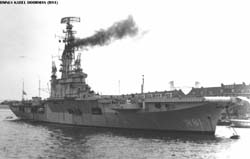
![[THUMBNAIL]](rnncv06.jpg) HMNLS Karel Doorman (QH1), the first carrier commissioned in
the Royal Netherlands Navy.
This carrier started life as a British freighter, but was converted
to an escort carrier prior to completion, and commissioned 12 Dec 1943
as HMS Nairana. After WWII she was loaned to the Netherlands to
help in rebuilding the shattered Dutch navy; she commissioned in Dutch
service 20 March 1946.
HMNLS Karel Doorman (QH1), the first carrier commissioned in
the Royal Netherlands Navy.
This carrier started life as a British freighter, but was converted
to an escort carrier prior to completion, and commissioned 12 Dec 1943
as HMS Nairana. After WWII she was loaned to the Netherlands to
help in rebuilding the shattered Dutch navy; she commissioned in Dutch
service 20 March 1946.
![[THUMBNAIL]](rnncv08.jpg) A port-side view of HMNLS Karel Doorman (QH 1).
She has been repainted from the wartime camoflage into a plain gray scheme.
A port-side view of HMNLS Karel Doorman (QH 1).
She has been repainted from the wartime camoflage into a plain gray scheme.
![[THUMBNAIL]](rnncv07.jpg) An overhead view of HMNLS Karel Doorman (QH1), probably
late in her career.
The carrier was returned to the RN in 1948 and resold into merchant service.
She survived until 1971 when she met the cutting torch at Faslane,
Scotland.
An overhead view of HMNLS Karel Doorman (QH1), probably
late in her career.
The carrier was returned to the RN in 1948 and resold into merchant service.
She survived until 1971 when she met the cutting torch at Faslane,
Scotland.
![[THUMBNAIL]](rnncv09.jpg) The second HMNLS Karel Doorman (R81) as first commissioned.
This carrier was built as the light fleet carrier HMS Venerable,
completed early in 1945. Decommissioned in 1947, she was sold to
the Dutch in 1948. She recommissioned as HMNLS Karel Doorman 28
May 1948, taking the name of the previous Dutch carrier. Initially she
operated with minimal modifications, as seen here.
The second HMNLS Karel Doorman (R81) as first commissioned.
This carrier was built as the light fleet carrier HMS Venerable,
completed early in 1945. Decommissioned in 1947, she was sold to
the Dutch in 1948. She recommissioned as HMNLS Karel Doorman 28
May 1948, taking the name of the previous Dutch carrier. Initially she
operated with minimal modifications, as seen here.
![[THUMBNAIL]](rnncv10.jpg) Another view of Karel Doorman (R81) early in her Dutch career.
Another view of Karel Doorman (R81) early in her Dutch career.
![[THUMBNAIL]](rnncv11.jpg) Karel Doorman seen after her 1955-58 reconstruction
as angled-deck ASW/strike carrier.
This reconstruction included an englarged island, extended funnel,
new masts and new weapons, in addition to the angled deck and
associated flight deck changes.
Karel Doorman seen after her 1955-58 reconstruction
as angled-deck ASW/strike carrier.
This reconstruction included an englarged island, extended funnel,
new masts and new weapons, in addition to the angled deck and
associated flight deck changes.
![[THUMBNAIL]](rnncv12.jpg) A port-side view of Karel Doorman following her reconstruction.
The aircraft on deck appear to be S-2 Trackers; after the mid-1960's
Doorman operated as an ASW carrier only.
A port-side view of Karel Doorman following her reconstruction.
The aircraft on deck appear to be S-2 Trackers; after the mid-1960's
Doorman operated as an ASW carrier only.
![[THUMBNAIL]](rnncv14.jpg) Another view of Karel Doorman after her reconstruction.
Another view of Karel Doorman after her reconstruction.
Veinticinco De Mayo's age began to tell, and by the early 1980's she was in poor condition. After 1985 she did not move under her own power and was little but a hulk. A series of plans to rebuild and re-engine the ship produced no result, and she was formally stricken in 1997, and scrapped in 1999.